by Uchechi | Jul 23, 2015 | Blog
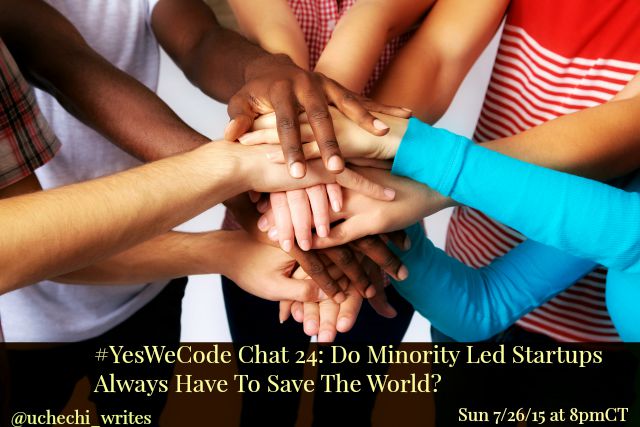
Yes We Code chat 24: Do Minority Led Startups Always Have To Save The World?
Sunday July 26th 2015
6pmPST/8pmCT/9pmEST
Connect with me on Twitter @uchechi_writes
More and more companies are creating products and services for social good. From well known shoe companies like TOMS to local businesses promoting giving back to the community, the idea is a good one that can only continue to better the world we live in.
But what happens when creating a social good business is assumed, especially for minority entrepreneurs? I recently attended a dinner for minority entrepreneurs where got to talking about the assumption that minority founders are supposed to create startups focused on “social good.” During the conversation, we agreed that this expectation is not only a problem, but creates mixed messages for minority led startups. On the one hand, we’re supposed to be focused on making money and have an investment worthy business model. On the other hand, we’re supposed to do “social good” and create something that gives back to the community.
I have no problem with creating businesses for social good. I’d love to see more companies working to improve the world. The challenge I find with this notion is that this seems to be the companies that not only get funded, but this message is encouraged over and over again.
Funding sites like Kapor Capital focus on social good and that’s a positive, necessary thing, but how can we create companies that are profitable and may – or may not be – focused on social good? We’ll discuss this and more during the next yes we code chat.
Some questions to think about:
- What does “social good” startups mean to you?
- Do you feel a responsibility to “give back” via your company?
- Have you run up against funding obstacles because you’re not a “social good” startup?
- What do you think of startups like Tom’s shoes, who position themselves as social good?
- Do minority led startups always have to save the world?
Joining the chat for the first time? Check out the guidelines to help you make the most of it.
by Uchechi | Jul 9, 2015 | Blog
Yes We Code chat 23: How To Be Yourself Online
Sunday 7/12/15 at 6pmPT/8pmCT
Follow me @uchechi_writes
Last month was quite a month in history. It was definitely an emotional roller coaster. We went from the sadness and despair of the Charleston shooting to the joy of celebrating the right of all people to be legally married in the United States.
With all of the events happening, I’ve started talking to people I know about how we express/don’t express ourselves on social media when a major event happens and affects us all.
Did you have certain reactions to Charleston, but said nothing on Twitter because you weren’t sure if it was okay to express yourself? Did you feel like even though the world was changing in devastating ways, you’d be judged if you voiced what you really wanted to say? And that it might come back to haunt you?
During the next #yeswecode chat we’ll discuss what it means to have a voice, how to share it with others and how to balance sharing great content that is both public and private.
Questions to think about:
- Do you feel your social media presence should be different from our real life?
- How so?
- How do we be “real” in our social media presence in light of events like Charleston.
- What does being “real” in your social media presence meant to you?
- Do we have a responsibility to share our views/perspective?
See you on Sunday! Is this your first #yeswecode chat? Check out the guidelines to help you make the most of it.

by Uchechi | Jun 14, 2015 | Blog, creativity
I didn’t major in CS
I didn’t go to UX design school. I don’t think it even existed when I graduated from college in 2001. While I didn’t know anything about user experience design, I did know that I was interested in human behavior and interactions. User Experience Designers come from all different majors and backgrounds.I thought I’d major in Environmental Science. I loved learning how things worked, especially in the environment.During the spring of my freshman year, I took a poetry class that would eventually lead me to a career in technology.
Poetry Taught Me To Love Creativity and Language
I know this doesn’t sound like a predictable path, but it came out of going for something that ignited my curiosity, and led me to a career I didn’t even know I’d want to pursue.I was lucky to be mentored by the late poet June Jordan. She was one of the most published black writers in US history and I found a resonance in our stories. She encouraged me to express myself, to take risks, to get on stage even when my nerves were fried and my poems were drenched in my own fear. She made it valuable to take risks for something important, which was finding and owning my voice.
It was UX love at first wireframe
Years later, I found myself with a career as a professional poet, teacher and online copywriter. I’d spend weekends performing at conferences, jails, schools and more. What I loved most about this work was that it made me engage with my audience in a way that brought us all closer together. I’d write a range of content and was always aware of the language I used and the emotions conveyed based on the words I chose.I loved how language had an impact and could affect how we felt about anything. I learned to be intentional with my language and to use it wisely to convey exactly what I wanted to say.
User Experience Design Was Similar to Poetry
Online copywriting led me to discover UX, and it was love at first wireframe. Something about User Experience felt familiar.
- I got to have a voice and to use it.
- I could create something that allowed me to engage with my audience of users.
- It allowed me to be intentional about language and to not waste words.
- I had to think about who my audience was, and create experiences they could connect to.
- My platform was no longer a stage, but was now online. The world could connect. The world became my users.
- I could still be very creative and use writing as a tool.
- UX was also all about great copy, and I loved writing great copy to create great experiences. I was in tech heaven.
Want to know how to get into a tech career?
Start with finding your voice
If you’re headed to college, everyone will want to give you advice about what you should major in. You don’t know me and you might not want my advice, so I’ll tell you what I believe instead. I believe true creativity is rooted in any discipline that allows you to find a voice and to believe that your voice matters. Once you find that, you can express it in several ways (poetry, fine art, technology), but you have to trust that your perspective has value.
Suggested Classes To Take (You can do these now, even if you’re not in college anymore):
- Take classes that help you find your voice. Theater and creative writing classes are great for this.
- Take classes that reinforce the idea that mistakes are okay, and sometimes your best way of learning. Art classes are great for this.
- Take classes that encourage you to get up and share your perspective. Often in UX, you end up working in teams and need to be able to explain your ideas to others. Public speaking classes are great for this.
- Do something that allows you to take risks. Reading a poem during open mic night at your local bar is a great way to do this.
- Take classes in Architecture, which allows you to understand structural planning, which will help you in User Experience Design.[“Tweet “Creativity is rooted in the belief that you have a voice and that your voice matters enough to share it with the world.”]
Conclusion:
As a tech entrepreneur, I often get asked how I found this career path. My first response is usually something like this: “No, I didn’t major in CS, but I did study creative writing and education.” I was obsessed with language, perspectives and what it meant to have a voice and to trust that voice. It was trusting that voice that led me to love language enough to pursue a writing career, which led to online copywriting and then to UX. The skills I learned as a poet have also applied to my UX career. If you want to know how to get into tech, my advice is to find your creativity by finding your voice.How did you get into tech? How did you find your way to teI’d love to know your story. Hit me up in the comments!
by Uchechi | Jun 10, 2015 | Blog
Figuring out your startup business model isn’t easy, especially because a startup is an organization formed to search for a repeatable and scalable business model.
And often, our success depends on finding one that works and can help you scale quickly. But how do you know if you’re on the right track?
During the next #yeswecode chat, we’ll talk about your business model, exchange ideas and really tackle a difficult but necessary question: Can my business model help me scale?
Questions to think about:
- How are things working out with your current business model?
- What makes you question if you’re on the right track?
- What advice have you received and how have you implemented (or rejected) it?
- What’s the biggest hole in your business model?
- What are some obstacles for your specific type of business?
- Does anybody have firsthand experience dealing with these particular obstacles?
- Have you struggled with figuring out the best pricing? How did you resolve this?
- For any of you, has the pricing approach itself made or hurt your startup?
- Success or Horror stories, anybody?
Please check out the guidelines if it’s your first time joining the chat.
See you on Twitter!
