#YesWeCode Chat 27: Global UX & The Future of Tech Innovation

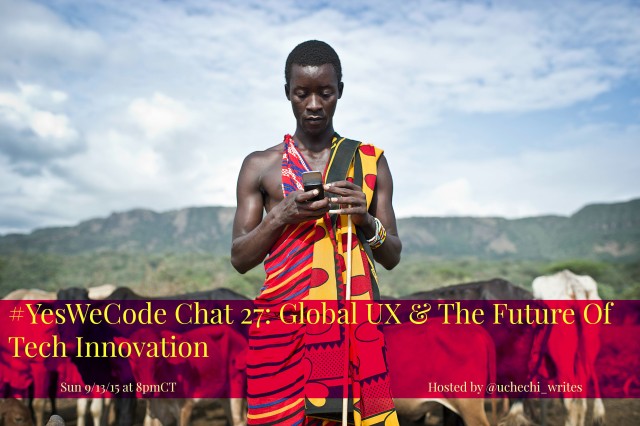
#YesWeCode Chat 27: Global UX & The Future of Tech Innovation

This week, Apple announced the new iPhone release for later this month. Around the world, customers will line up in Mexico City, Lagos, Lisbon and Manila to purchase Apples latest artistic release.In a world that has more mobile phones than toilets, it’s clear that global ad diverse customers make our products more profitable and valuable.

Isn’t it time we represent our world not just as consumers, but also as creators?

As tech innovators, how do we create user experiences that factor in the needs, desires and worldviews of global population?

Do we have a responsibility to innovate with a focus on global user experiences?

I think we do! As a UX Designer, I’m always thinking about how my Nigerian, American, Swedish, Mexican and Jewish family engages with the products I create.

How do I factor them into my design process?

The conversation about diversity in technology often centers around bringing diverse ideas to the table for the sake of inclusion, but the need for inclusion goes beyond fairness and equality. It also allows for better user experience, better design and more innovative products.

Stepping outside our comfort zone is not only necessary for self growth, it’s also good (no great) for business. The future of technology will focus on creating products for the more than 7 billion people in the world (4.5 billion have mobile technology) who look like less like the 19 year old white male Stanford grad and more like a kaleidoscope of ethnicities, languages and cultural contexts.

We are the answer to the question, “who will be best positioned to come up with products and services that will win in the global market.”

I think it’s time we make sure global centered UX is at the core of our tech diversity conversations and design innovation.

Questions to think about:

  1. What does global UX mean to you?
  2. Do you practice it?
  3. How has it impacted your design experience and perspective?
  4. As consumers, how would global centered design impact your user experience of a product?
  5. As creators, do we have a responsibility to “think globally?”
  6. As outsiders, do people of color have an advantage in the global market of tech products?
  7. If so how can we promote that?
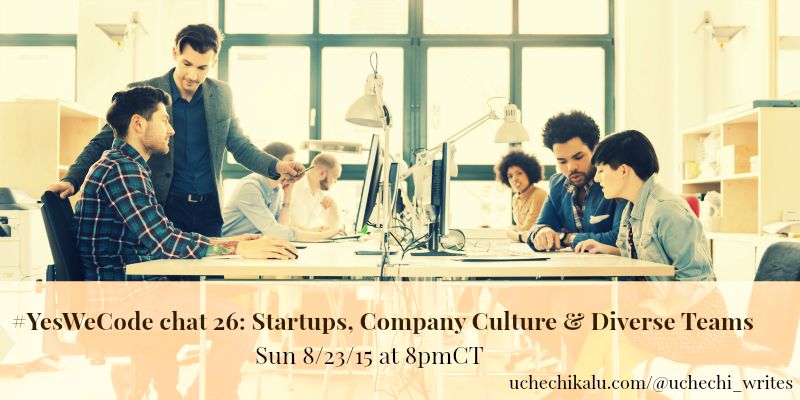
Yes We Code chat 26: Startups, Company Culture & Diverse Teams

Yes We Code chat 26: Startups, Company Culture & Diverse Teams

When it comes to building and sustaining a company, culture is key. From startups like Amazon to Airbnb, startup culture conversations are at the center of current conversations.

Discussing startup culture might be a key part of engaging the issue of tech diversity.

Recently, President Obama hosted the first ever Demo Day at The White House. This event generated a conversation around tech diversity and the lack of it as a cultural issue. Regardless of what you believe on this topic, company culture does shape what is accepted and acknowledged as appropriate within a tech company.

I think it’s really important to ask ourselves about the cultures we’re trying to create and what roles we as founders play in supporting or dismantling certain assumptions and behaviors within our companies.

How does the culture we create impact the future of our companies? Does it matter? How do we make room for all of us? The single mothers, the full time parents/techies and everyone and anyone who might not be seen as a cultural fit in an industry that lacks diversity in almost every way.

Join us for the next #yeswecode chat to discuss startups, company culture and the tech culture we’re trying to create.

Questions to think about:

  1. How do we make diversity part of our company culture/DNA  from the beginning?
  2. Which company culture elements are most important to you.? Why?
  3. Do startups founders have a responsibility to positively shape company culture from the beginning?
  4. What tips would you give to company founders about creating inclusive culture?
  5. How do we expand the conversation about startup culture to include everyone?

See you there!

Joining the #yeswecode chat for the first time? Check out the guidelines to help you make the most of it.

Photo Credit

Yes We Code 25: Why The Tech Diversity Conversation Needs A New Narrative

Yes We Code 25: Why The Tech Diversity Conversation Needs A New Narrative

#YesWeCode chat #25: Why The Tech Diversity Conversation Needs A New Narrative
Sunday 8/9/15
6pmPT/8pmCT/9pmEST

Two recent events influenced this Yes We Code chat topic. Last weekend was James Baldwin’s birthday and I celebrated by writing about the lessons I learned from him, and his take on how to go after what you want and actually get it. In his historic “Rap on Race” conversation with Margaret Mead, he talks about how he needed to “change the narrative” of what was expected for his life in order to change his life.

During #YesWeCode chat #24, we discussed the assumption/expectation of minority startup founders to create businesses focused on social good. While that wasn’t every founders experience and we didn’t come up with an answer, we did conclude that maybe we need to rethink how we view the following conversations within the tech diversity:

  •  Social good can also be profitable.
  • Minority entrepreneurs can create companies that are profitable.
  • The solution towards more tech diversity isn’t about one solution, but addressing the whole pipeline.

What if the way to really achieve tech diversity is to change the internal and external narratives we tell ourselves about what that means and what it will take? What if in order to engage this topic we need to know and understand the real underlying issues and concerns?What if we refuse to accept that lack of minority CS majors is at the heart of the lack of diversity in tech? What if we choose to rethink the expectations and assumptions we put on ourselves? What if, in the end, we need to “change the narrative” we’ve either created or accepted about what’s possible in the greater tech diversity conversation.
This Sunday, we’ll talk about this and more.

Questions to think about:
1. Is there a consistent tech diversity narrative?
2. What does it say?
3. What assumptions about tech diversity impact how you see yourself and your work?
4. If there are many tech diversity narratives, which ones do you think we need to change? Why?
5. How can we create a new narrative that includes the needs of youth, entrepreneurs and tech startup entrepreneurs?

New to the #yeswecode chat? Check out the guidelines to help you make the most of it!

James Baldwin Got It Right: Change The Narrative, Change Your Destiny

James Baldwin Got It Right: Change The Narrative, Change Your Destiny

James Baldwin gave me the gift of possibility.

James Baldwin’s birthday is today, and so many things are going through my head. To most, he is a prolific poet and writer. His books changed the American conversation on race. He deserves all the praise for his beautiful and insightful prose and poetry. He is in the truest sense, a writer.

For me, James Baldwin is all of these things and the person who gave me the gift of possibility and showed me the power of looking beyond your circumstances to see what else was possible in your life.

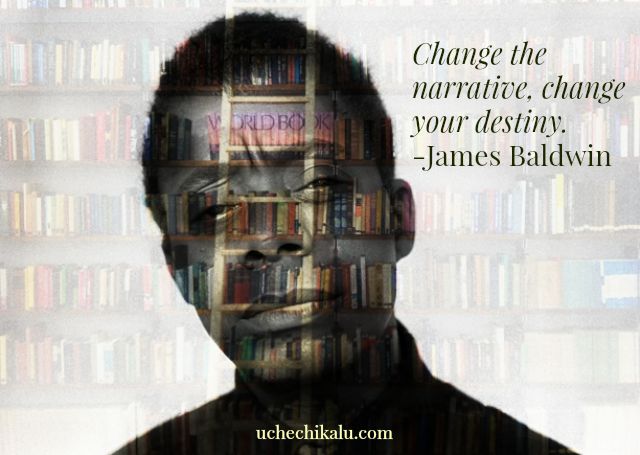
He allowed me to do just that:Change the narrative and change my destiny.

If you can change the narrative, you can change your destiny.

This idea that we must change the narrative of our lives in order to change our destinies sprung out of a conversation on race with James Baldwin and Margaret Mead (link to article here). During that talk, he shares how he started imagining other possibilities for his life from childhood.

The assumed narrative for my life scared the hell out of me: I was supposed to go to stay in a small town, study medicine, become a doctor and be married to a man from my village all before I was 30 years old.

There were many nights when I lay in bed reading Baldwin. My mother kept rooms full of books and guarded them like her most precious jewels. In these piles I found Baldwin, and I found a new, another, narrative. Another possibility. Another outcome for my life. And once I found it, I started telling that narrative to other people.

I started telling a story where I studied in the university and hid in the corners of libraries, dreaming of writing like Baldwin. I told my parents that I would not have an arranged marriage. I was changing the story.

He would remind his mother that he was going to be a great writer someday and would buy her nice things. She replied with a voice that said: “This is not what happens for people like you, but I’ll let you keep dreaming.”

Today, I’m married to a man I deeply love and life worked out even though I didn’t go to med school or back to my village to get married. I’m no longer trying to change my destiny from a child’s perspective, but I am doing something that historically has not included me in its narrative: I am a tech entrepreneur and startup founder.

The tech diversity conversation needs a new narrative.

That narrative is being written now. For too long, that narrative has said that not enough minorities and women major in CS, which leads to a lack of diversity in tech. That old narrative says you’re more likely to make it in technology if you don’t look or sound anything like me. That old narrative makes us all afraid of turning the page over, starting with a blank page and redefining what tech entrepreneurs can and should be.

I get why it’s scary. Changing the narrative of possibility in ones life involves the willingness and hunger for another possibility that’s usually very different from what’s assumed or imagined. Starting with a blank page is not easy and can be difficult, but it can also be an opportunity.

I’d like to change the diversity + tech narrative by asking anyone interested in tech to start learning and asking questions. Sign up for classes, connect with organizations focused on teaching coding skills, join conversations on twitter about tech and diversity and when you feel that you’re not smart enough or good enough, remember something that Baldwin shared from his conversation with Margaret Mead:

“Once people know what they know, they make the unconscious assumption that they were born knowing what they know, and forget that they had to learn everything they know.”

Remember that tech changes every day, and we’re all just winging it and often unsure and uncertain. This new narrative is about what you want for your tech career and how you plan to get there. This new narrative says we’re all capable of working at a Google or creating one, and sets a path to help us get there. This new narrative says that despite feelings of Imposter Syndrome (link), we go for what we want anyway.

Happy Birthday James Baldwin. It’s because of people like you that I’ve decided to write a new narrative for my life.

Photo credit